
How Online Reputation Management Protects Local Visibility
 par Ikram Ayoub
A perfectly optimized Google Business Profile can still lose the sale if a customer notices unanswered one-star reviews or a phone number that's been wrong for months. This guide covers how reputation management protects the value of local SEO — monitoring, responding, correcting listings, and handling genuine policy violations the right way.
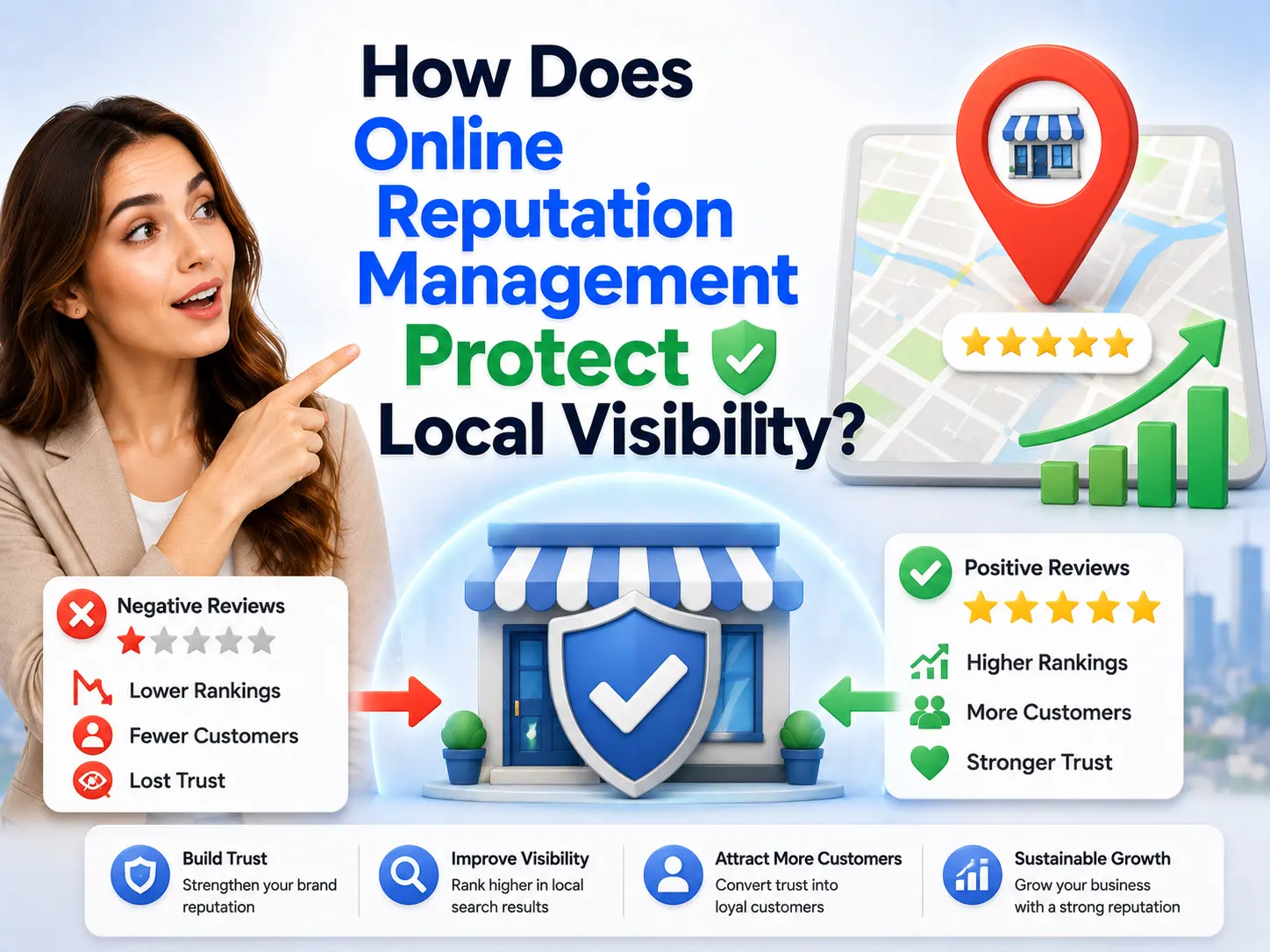
How Does Online Reputation Management Protect Local Visibility?
Online reputation management protects local visibility by making sure the trust customers place in a business survives the moment they click through to its reviews — monitoring feedback, responding professionally, correcting outdated listings, and reporting genuine policy violations, so three unanswered one-star reviews don't undo what the SEO work built. A strong reputation doesn't guarantee higher rankings, but it does determine whether visibility turns into a call, a visit or a sale — and for multi-location businesses, it also surfaces which specific branch needs attention before it drags down the brand.
A business can have a perfectly optimized Google Business Profile, an excellent website, and prominent placement on Google Maps. But then a potential customer sees three unanswered one-star reviews. Or an outdated phone number. Or a complaint that has been sitting unanswered for six months. The customer moves on.
This is the part of local SEO that many businesses overlook. Visibility gets attention. Reputation influences trust. And trust determines whether that visibility turns into a call, visit or sale.
What Is Online Reputation Management?
Online Reputation Management, or ORM, is the process of monitoring and managing how a business is represented online.
This can include:
- Google reviews
- Review platforms
- Business directories
- Social media
- Industry websites
- Search results
- Third-party mentions
The objective is not to eliminate every negative opinion.Real businesses receive criticism.
The goal is to create an accurate, credible and trustworthy digital presence.
That means:
- Encouraging genuine customer feedback
- Responding professionally
- Correcting inaccurate information
- Reporting policy violations
- Identifying recurring customer problems
- Monitoring brand mentions
Good reputation management is proactive. It does not begin only after a crisis.
Does Reputation Directly Affect Local SEO Rankings?
This question requires some nuance.
A negative review does not automatically mean:
"Your Google Maps ranking will disappear."
Local search visibility depends on multiple factors.
However, reputation plays an important role in the broader visibility-to-conversion process.
Reviews and public feedback can influence:
- Customer trust
- Click behaviour
- Calls
- Website visits
- Store visits
- Conversion decisions
If customers repeatedly choose competitors because those businesses appear more trustworthy, a business can lose valuable opportunities even while remaining fully visible in search. This is why reputation should be viewed as part of the wider local search ecosystem, not a separate concern from it.
Why Do Google Reviews Matter for Local Visibility?
Imagine searching "best marketing agency near me" and seeing three businesses: one at 4.9 stars, another at 4.6, and a third at 3.1. Even if all three appear in the search results, the customer's attention narrows to the first two almost immediately — this is the difference between being visible and being chosen.
Reviews reduce uncertainty and provide social proof, giving potential customers insight into other people's experiences.
That is why [How Google Reviews Affect Local SEO and Customer Trust] is such an important part of a broader local visibility strategy.
Can Negative Reviews Make a Business Disappear From Google Maps?
Usually, no.A few negative reviews do not automatically remove a legitimate business from Google Maps.
In fact, a completely perfect review profile may not always appear as natural as a profile with a realistic range of customer experiences.
The bigger concern is the overall pattern.
For example:
- Consistently declining ratings
- Repeated unresolved complaints
- A sudden wave of suspicious reviews
- Poor response management
- Incorrect business information
These problems can damage customer confidence.
The correct response is not to panic — it is to investigate, identify the problem, and determine whether it reflects a genuine customer experience or a potential policy violation.
How Should Businesses Respond to Negative Reviews?
The worst response is an emotional one.
Avoid statements such as:
"You're lying."
"You're just a competitor."
"We don't care."
Even if a review appears unfair, an aggressive public response can create a second reputation problem.
A professional response should:
- Acknowledge the customer's concern
- Remain calm
- Avoid revealing private information
- Offer a path to continue the conversation privately
- Demonstrate professionalism to future readers
Remember: you are not only responding to the reviewer. You are speaking to every potential customer who reads the exchange later.
Should Businesses Remove Negative Reviews?
Businesses generally cannot remove legitimate negative reviews simply because they are unfavorable. If a review violates a platform's policies, it may be eligible for reporting; if it reflects a genuine customer experience, the better approach is usually to respond professionally and address the underlying issue.
This distinction matters: reputation management is not about creating a fake perfect image. It is about protecting the integrity and credibility of the business's online presence.
What If a Competitor Posts Fake Reviews?
This can be a serious reputation issue.
Imagine a business suddenly receives:
- Multiple one-star reviews
- From people who were never customers
- Within a very short period
The business may suspect coordinated or fraudulent activity.
The first step is documentation.
Record:
- Review URLs
- Dates
- Reviewer names
- Patterns
- Relevant evidence
Then use the platform's official reporting and appeal processes where available.
Do not retaliate with fake reviews. Do not publicly accuse competitors without evidence. Focus on documentation and appropriate platform procedures
professional monitoring can help identify unusual patterns before they become larger reputation problems.
How Does Reputation Management Connect With Google Maps?
Consider the customer journey.
Step 1: A customer searches Google.
Step 2: Your business appears on Maps.
Step 3: The customer checks reviews.
Step 4: The customer compares your business with competitors.
Step 5: The customer decides whether to call, visit or leave.
Your Google Maps visibility is only the beginning.
Your reputation influences what happens next.
This is why reputation management protects the value of local SEO.
The objective is not only:
"Appear in search."
It is:
"Appear, build trust and convert attention into action."
For businesses struggling to appear in the first place, see [Why Your Business Isn't Showing on Google Maps].
How Does Reputation Management Help Multi-Location Businesses?
Multi-location businesses face a unique challenge — one branch may have an excellent reputation while another is struggling. The overall brand average can look acceptable while a specific branch is quietly losing customers, because a customer searching for that branch only ever sees that branch's profile.
This is why reputation monitoring should happen at both brand level and location level.
For businesses operating across several locations, this connects directly with [Local SEO for Multi-Location Businesses].
A strong brand cannot completely hide a weak local experience — each location needs its own attention.
What Role Does Review Generation Play in Reputation Management?
Reputation management is not only about responding to negative reviews — it is also about making it easy for satisfied customers to share genuine experiences. A business may have hundreds of happy customers but only a handful of reviews, and that gap is itself a reputation problem.
Businesses can encourage genuine feedback by:
- Asking customers after successful interactions
- Providing direct review links
- Using QR codes
- Including review requests in follow-up communication
The process should remain authentic.
Can Reputation Management Improve AI Search Visibility?
The relationship is indirect.
AI search systems may encounter information about businesses across:
- Websites
- Business profiles
- Reviews
- Directories
- Industry platforms
- Third-party publications
A consistent and credible digital footprint can help establish a clearer picture of a business.
However, no reputation management tactic can guarantee that ChatGPT, Gemini or another AI system will recommend a particular company.
The practical goal is to ensure that your business information is:
Accurate.
Consistent.
Relevant.
Trustworthy.
This connects reputation management with the broader principles of [What Is GEO? A Complete Guide to Generative Engine Optimization] and [How to Improve Your Business Visibility in ChatGPT and Gemini].
How Does Reputation Management Protect Against Outdated Information?
Reputation problems are not always caused by reviews — sometimes they start with inaccurate business information: a directory lists the wrong address, a review platform shows old opening hours, a business profile contains an outdated phone number. Customers encounter the wrong information, become frustrated, and that frustration becomes a negative customer experience.
This is why reputation management and citation management often overlap. The guide [How to Fix Duplicate and Outdated Business Listings] explains how these problems can be identified and corrected. Accurate information is part of reputation.
What Is a Reputation Monitoring System?
A basic monitoring system can track:
- New reviews
- Review ratings
- Customer sentiment
- Brand mentions
- Business listings
- Negative trends
- Competitor reputation
The objective is speed.
A business that identifies a problem after six months has fewer options than one that notices it after six days.
Monitoring creates an opportunity to:
- Investigate
- Respond
- Correct
- Escalate
- Improve
This turns reputation management from crisis response into ongoing protection.
How Quickly Should Businesses Respond to Reviews?
Businesses should monitor reviews regularly and respond in a timely manner.
There is no universal response time that fits every business.
However, long periods of silence can make a business appear disengaged.
A simple review workflow can categorize feedback:
Positive→ Thank the customer.
Neutral→ Acknowledge the feedback.
Negative→ Respond professionally and investigate.
Potentially fraudulent→ Document and report through the appropriate platform process.
This creates a repeatable system.
What Is the Biggest Online Reputation Management Mistake?
The biggest mistake is waiting until reputation becomes a crisis.
Businesses often react only when:
- Ratings suddenly collapse
- Negative reviews become widespread
- A competitor attack is suspected
- A location starts losing customers
By then, the damage may already be visible.
A proactive strategy monitors reputation continuously.
The goal is not perfection.
It is resilience.
How Can Businesses Build a Stronger Local Reputation?
A sustainable reputation strategy combines several elements.
- Monitor reviews — know what customers are saying.
- Respond professionally — show that the business listens.
- Encourage genuine feedback — give satisfied customers an easy way to share their experience.
- Maintain accurate listings — prevent customers from encountering outdated information.
- Address real problems — fix recurring operational issues rather than simply responding to symptoms.
- Report policy violations — use official platform processes when reviews or content violate policies.
- Monitor each location — identify local problems before they affect the wider brand.
This creates a reputation system rather than a one-time cleanup.
What Should a Business Do When Its Reputation Is Declining?
Start with an audit — don't immediately assume the problem is "bad reviews." Look at the entire customer journey
Check:
- Google reviews
- Other review platforms
- Business directories
- Google Business Profile information
- Website information
- Review response quality
- Recurring customer complaints
- Location-level performance
Then separate the problems into three categories:
Data problems→ Incorrect or outdated information.
Reputation problems→ Negative customer sentiment or recurring complaints.
Policy problems→ Potentially fraudulent or policy-violating content.
Each requires a different solution.
This prevents businesses from treating every reputation issue as a simple review-removal problem.
How AB Media Team Fixes This — On an Ongoing Basis
Monitoring reviews across every platform, responding professionally to each one, and catching outdated listings before a customer does is a full-time job the moment a business grows past a handful of locations or a few dozen reviews a month.
AB Media Team's 12-Month Google Visibility & Reputation Management Package includes professional, individual responses to Google reviews, active policy-compliant review requests to real customers, review of negative feedback for genuine policy violations, and directory alignment across Golocal.de, Cylex.de, KennstDuEinen.de, ProvenExpert.de and 11880.de — so accurate information and a monitored review profile work together instead of being handled separately.
FAQ
Does online reputation management improve Google Maps rankings?
ORM does not guarantee higher rankings, but it can support the broader visibility and conversion ecosystem by improving trust, reviews and accurate business information.
Can I remove negative Google reviews?
You generally cannot remove legitimate reviews simply because they are negative. Reviews that violate platform policies may be eligible for reporting.
Should I respond to every negative review?
In most cases, responding professionally is advisable, especially when future customers may read the interaction.
Can fake reviews be removed?
Potentially, if they violate the platform's policies. Businesses should document the issue and use the platform's reporting and appeal procedures.
How often should I monitor my online reputation?
Regular monitoring is recommended. The ideal frequency depends on the size of the business, review volume and number of locations.
Does ORM matter for multi-location businesses?
Yes. Each location can develop a different reputation, so businesses should monitor both brand-level and location-level feedback.