
What Is NAP Consistency and Why Does It Matter for Local SEO?
 door Ikram Ayoub
NAP consistency is about making sure your business Name, Address and Phone number agree everywhere they appear online. This guide breaks down what NAP means, why a single wrong listing can quietly cost customers and rankings, and the step-by-step process for finding and fixing every mismatched version of your business.
What Is NAP Consistency and Why Does It Matter for Local SEO?
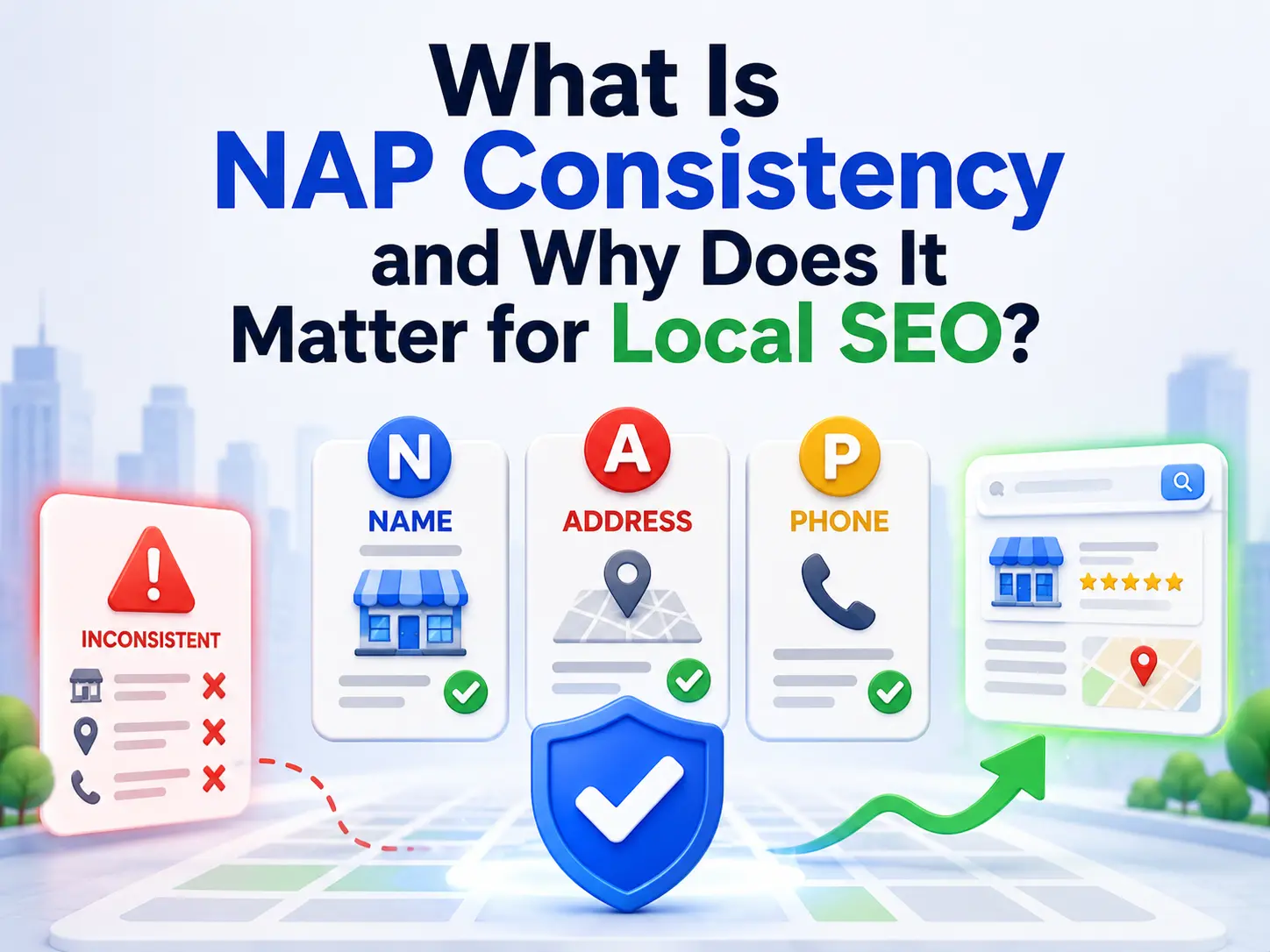
NAP stands for Name, Address and Phone number — the three identifiers Google, directories and AI systems use to confirm you're a real, findable business. A full audit of a small business often turns up five, sometimes ten, conflicting versions of that same information scattered across Google, directories and review platforms — and it's that inconsistency, not any single wrong listing, that erodes local visibility.
Imagine a customer searches for your business. Google shows one phone number. Your website shows another. A directory lists an old address. A review platform uses a different business name. The customer has one question: which version is correct?
Now imagine a search engine encountering the same information. It has a similar problem. This is why NAP consistency matters.
But there is a common misconception: NAP consistency is not a magic SEO switch. Fixing one phone number does not automatically send a business to the top of Google.
The real value is broader — accurate business information creates a clearer, more trustworthy digital identity. And when that identity is fragmented, the consequences can extend beyond rankings: customers can lose trust, calls can go unanswered, visitors can arrive at the wrong address, and old listings can continue appearing in search results.
So the real question is not:
"Do I need NAP consistency?"
It is:
"How many different versions of my business exist online right now?"
What Does NAP Consistency Actually Mean?
NAP consistency means your core business information is accurately represented across important online sources.
For example:
Business Name: AB Media Team Address: Example Street 10, Berlin Phone: +49 XXX XXXXXXX
This information may appear on:
- Google Business Profile
- Official website
- Local directories
- Industry platforms
- Review websites
- Social profiles
- Business associations
- Partner websites
The goal is not to force every platform to use identical punctuation or formatting. The goal is to avoid meaningful contradictions
for example:
| Website | Directory | |
|---|---|---|
| Example Street 10 | Example Street 10 | Example Street 15 |
Or:
| Directory | |
|---|---|
| +49 123 456789 | +49 987 654321 |
These differences can create confusion. That is why NAP consistency should be viewed as part of a wider digital identity strategy.
Why Does NAP Consistency Matter for Local SEO?
Search engines need to understand real-world businesses.
They need to determine:
- Is this the same business?
- Where is it located?
- What does it offer?
- Is the information current?
- Which sources are reliable?
Accurate information makes those relationships easier to understand.
But local SEO is more complex than NAP alone.
Google's local results are influenced by factors such as:
- Relevance
- Distance
- Prominence
- Reviews
- Website signals
- Links
- Business information
So it would be inaccurate to say:
"Fixing NAP automatically improves rankings."
The more useful conclusion is:
Inconsistent business information can create confusion, while accurate information supports a cleaner and more trustworthy local presence.
This is one reason NAP consistency is discussed in our main guide, Why Do Businesses Disappear From Google, ChatGPT & Gemini?.
That article looks at the larger problem: how inconsistent information across Google, directories, reviews and websites can make a business harder to verify.
What Does the "N" in NAP Mean?
The N stands for Name.
Your business name should reflect the name your customers actually know.
Avoid adding unnecessary keywords simply because you want to rank for them.
For example:
Real business name:
AB Media Team
Keyword-stuffed variation:
AB Media Team – Best Local SEO & Reputation Management Agency Berlin
If the second version is not the company's real-world name, it should not be used simply to target search terms.
Accuracy comes first.
This principle also applies when a business rebrands. If your company changes its name, you need to review where the old name still appears — otherwise, customers may encounter two versions of the same business.
What Does the "A" in NAP Mean?
The A stands for Address.
Your physical business address should be accurate wherever it is publicly listed.
This becomes especially important when a business:
- Moves
- Opens another branch
- Closes a location
- Changes office buildings
- Expands into a new city
One of the most common problems is updating Google but forgetting older directories. The result: your current profile shows one address, old listings show another, customers become confused, and search engines encounter historical information.
The problem becomes even more complicated when multiple branches are involved. This is why businesses with several locations need a structured approach to local SEO and location management.
What Does the "P" in NAP Mean?
The P stands for Phone number.
Your main business contact number should be accurate across important sources.
An outdated number can cause an immediate customer-experience problem: a potential customer calls, nobody answers, the number no longer exists, or the call reaches a different company — and that customer may never try again.
However, businesses can legitimately have multiple numbers.
For example:
- Main office
- Location-specific numbers
- Department numbers
- Call tracking numbers
The objective is not to eliminate every secondary number. The objective is to make sure your phone structure is intentional and does not accidentally create conflicting identities.
How Can You Check Your NAP Consistency?
Start with your official business information, then compare it against important online sources. Check:
- Google Business Profile
- Website
- Major directories
- Industry-specific platforms
- Review websites
- Social profiles
- Local business associations
- Important partner websites
Create a simple audit.
| Platform | Name | Address | Phone | Action |
|---|---|---|---|---|
| Correct | Correct | Correct | None | |
| Website | Correct | Correct | Correct | None |
| Directory A | Correct | Old | Correct | Update |
| Review Platform B | Correct | Correct | Old | Update |
Create a simple audit — this makes problems visible. You may find that the problem is not one incorrect listing. It may be five. Or ten. That is when a simple profile update becomes a proper local SEO cleanup project.
Should You Build Hundreds of Local Citations?
No — not automatically. This is where local SEO advice often becomes too simplistic. More listings do not automatically mean better rankings, and a business with hundreds of irrelevant, low-quality directory profiles can still have a weak digital presence.
The better strategy is to prioritize:
- Relevant local directories
- Trusted business platforms
- Industry-specific websites
- Important review platforms
- Local organizations
For businesses in Germany, this may include relevant platforms such as Golocal, Cylex, 11880 and others depending on the industry.
The goal is not:
"Be everywhere."
The goal is:
"Be accurately represented where it matters."
That distinction can save businesses considerable time.
How Do Duplicate Listings Create Problems?
Duplicate listings can appear for many reasons.
A business may have:
- An old Google profile
- A new Google profile
- A previous address
- A listing created by another person
- Multiple directory entries
- Profiles created after a rebrand
The problem is that customers may not know which one to trust. Before creating a new listing, search for existing profiles. If duplicates exist, determine which profile represents the legitimate business, then follow the relevant platform process to merge, correct, claim, or remove it.
Do not simply create another profile and hope the problem disappears — that can make the digital footprint even more fragmented.
For a deeper look at this problem, our upcoming guide [How to Fix Duplicate and Outdated Business Listings] will explore the cleanup process in more detail.
Can NAP Inconsistency Affect AI Search Visibility?
AI search introduces another reason to think carefully about business information. AI-powered systems may use information from multiple sources to understand real-world entities.
Imagine a system encounters:
Website: Berlin Google: Berlin Directory A: Berlin Directory B: Munich Directory C: Old phone number
There is now a conflict.
This does not mean the business will automatically disappear from ChatGPT or Gemini — AI visibility depends on many factors. But fragmented information can make the business harder to understand and verify.
That is why businesses should think beyond traditional rankings
The goal is to build a digital identity that is:
- Clear
- Accurate
- Consistent
- Accessible
- Verifiable
For the larger picture, read [Why Do Businesses Disappear From Google, ChatGPT & Gemini?].
The article explores how businesses can become difficult to verify when information across Google, directories and websites does not align.
How Often Should You Audit NAP Information?
There is no universal schedule.
But you should review your business information whenever something important changes.
For example:
- New address
- New phone number
- Rebranding
- Website migration
- New location
- Closed location
- New opening hours
For many businesses, a quarterly audit is a practical starting point. Businesses with multiple locations may need more frequent monitoring. The important thing is to create a repeatable process — don't wait for customers to tell you that your phone number is wrong, and don't wait until someone arrives at your old address.
Why Is Old Business Information So Difficult to Remove?
Because the internet remembers.
A business may update its current profile.
But older information can remain on:
- Directory websites
- Review platforms
- Social profiles
- Archived pages
- Old partner websites
This creates a hidden problem.
You may believe your business information is correct because your Google profile is correct.
But a broader search reveals several outdated versions.
That is why a proper local SEO audit should ask two questions:
Where are we listed correctly?
And:
Where are we still listed incorrectly?
The second question is often where the real problems appear.
What Is the Best Way to Fix NAP Inconsistencies?
A practical process looks like this:
Step 1: Establish the correct information
Create one verified source of truth for your business details.
Step 2: Audit important platforms
Start with Google, your website and relevant directories.
Step 3: Prioritize meaningful errors
Focus first on major contradictions involving name, address and phone number.
Step 4: Fix duplicates
Claim, merge, correct or remove duplicate listings according to platform rules.
Step 5: Monitor changes
Review your information regularly.
Step 6: Connect your local SEO strategy
Make sure your website, reviews, services and business profiles all communicate the same identity.
This final step is critical: NAP consistency alone does not create a strong local presence. It supports a larger strategy.
Expert Takeaway: What Should Businesses Focus on First?
If you discover inconsistent NAP information, do not panic — you do not need to fix every mention of your business across the entire internet overnight. Start with the platforms that matter most:
- Google Business Profile
- Your official website
- Important local and industry directories
- Major review platforms
- Other trusted references
Then monitor. The objective is not perfection for its own sake. The objective is to create a clear and credible digital identity.
How AB Media Team Fixes This — On a Fixed Timeline
Finding five or ten conflicting versions of your business information is common — fixing all of them across separate platform dashboards, each with its own dispute and verification process, is the part most owners don't have time for.
AB Media Team's 12-Month Google Visibility & Reputation Management Package
FAQ
What does NAP stand for in local SEO?
NAP stands for Name, Address and Phone number. These are core identifiers used to represent a local business online.
Is NAP consistency a direct Google ranking factor?
It should not be treated as a simple standalone ranking factor. Accurate business information can, however, support a clearer digital presence and reduce customer confusion.
Does my business name need to be identical everywhere?
It should accurately represent the real-world business. Minor formatting differences may not always matter, but misleading or keyword-stuffed names should be avoided.
How can I find incorrect business listings?
Search for your business name, address and phone number across Google, directories, review platforms, social profiles and industry websites.
Should I remove every duplicate listing?
Not necessarily. The correct action depends on the platform. Some duplicates should be merged, claimed or corrected rather than simply deleted.
How often should I check NAP consistency?
Check whenever your business changes its name, address, phone number, website or locations. A periodic audit is also useful.
Does NAP consistency affect ChatGPT and Gemini?
Consistent information can help create a clearer online representation of your business, but AI visibility depends on many other factors, including website content, third-party references and business relevance.
Final Thoughts
NAP consistency may sound like a technical SEO detail, but the underlying question is simple: can customers and search systems confidently identify your business?
If your website says one thing, Google says another and directories show outdated information, your digital identity becomes fragmented. Fixing that fragmentation is one of the foundations of stronger local visibility.
But consistency is only the beginning. Once customers can find the correct business, another question determines whether they will trust it: what do they see when they read your reviews?
That is where local SEO and reputation management meet.