
How to Get More Google Play Store Reviews and Increase Downloads in 2026
 von Ikram Ayoub
Your star rating decides — in seconds — whether a visitor installs or leaves. Learn how to get more genuine Google Play Store reviews in 2026, strengthen your ranking, and lower your cost-per-install, without risky or policy-violating tactics.
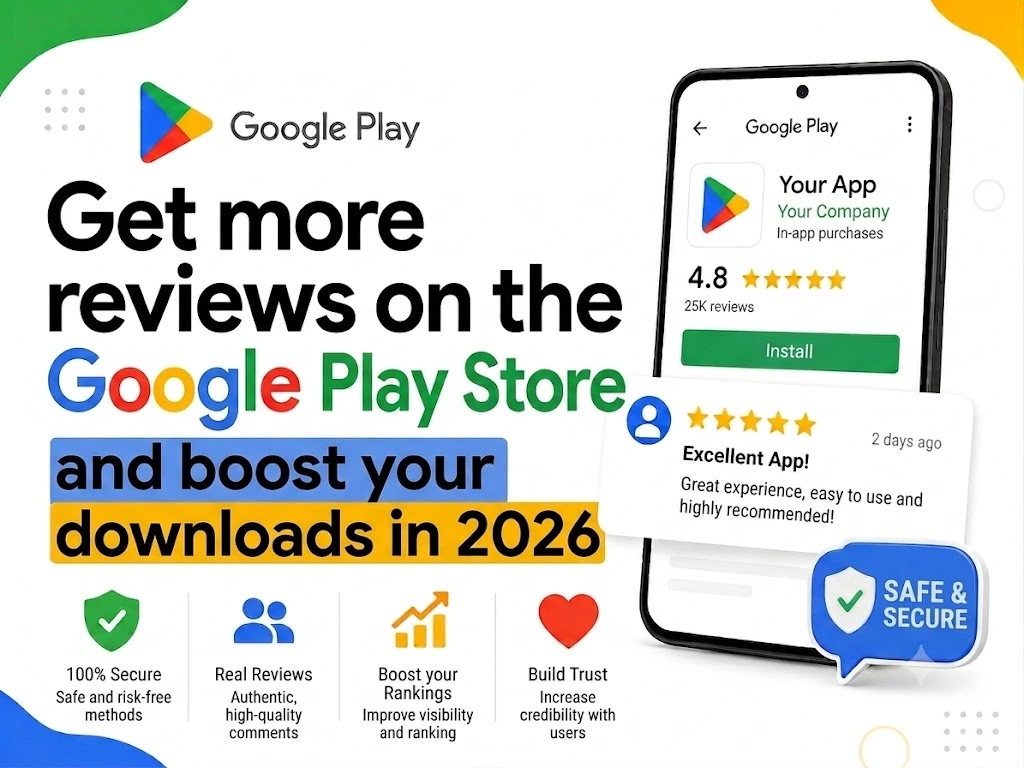
How to Get More Google Play Store Reviews and Increase Downloads in 2026
In a marketplace crowded with over 3 million applications, your Google Play Store rating isn't a vanity metric. It's a critical ranking signal and the very first trust indicator a stranger sees before handing over their phone's storage space.
Before downloading any new app, most users check the same four things:
⭐ Your average star rating
💬 The total number of reviews
🕒 How recent those reviews are
🤝 How you respond to user feedback
Those few seconds determine everything. Either someone becomes a user—or they choose a competitor. Google's Play Store algorithm in 2026 makes this gap wider than ever: ratings and review velocity now feed directly into multiple ranking and visibility systems.
Before We Talk About Growth...Here's What Inaction Really Costs
You don't lose downloads because your app is bad. You lose them because users make trust decisions in seconds.
Every Play Store visitor silently asks one question:
"Can I trust this app?"
If the answer isn't immediately obvious, they leave — and rarely come back.
Most developers believe they have a traffic problem. In reality, they have a conversion problem.
| 77% | 23% | 5× |
|---|---|---|
| of users check reviews before installing a new app | of developers have a structured review strategy | higher cost-per-install when your rating drops below 4.0 |
⚠️ How a weak profile silently burns every channel
- 📉 Reduced Conversion Rate: Profile visitors will not download the app if compelling positive reviews are missing.
- Poorer Algorithm Ranking: The Google Play Store algorithm penalizes apps with low average ratings through a massive loss of search visibility.
- High Marketing Costs: Without organic discoverability, you are permanently forced into expensive paid ads (Google Ads, Social Media), which perform inefficiently due to the weak profile.
- 😟 Distorted Brand Image: Individual, frustrated users (e.g., due to a temporary bug) dominate the first impression if there is no positive balance.
- Competitive Disadvantage: Competitor apps with a strategically maintained review profile effortlessly draw away your potential users.
⚠️ What starts as a reputation problem quickly becomes a financial problem—and eventually an existential one for your app.
8 Proven Strategies to Increase Google Play Store Reviews in 2026
| Strategy | How It Works |
|---|---|
| In-App Review API | Prompt users to rate without leaving your app. Trigger after positive moments — a win, completed task, or milestone — never after a crash or on first launch. Google limits prompts to roughly once every 30 days per user. |
| Behavioral User Scoring | Score user behavior and only trigger the review dialog above a set threshold. This single filter can improve your average rating by 0.3–0.6 stars within 60 days by ensuring only satisfied users are prompted. |
| Respond to Every Review | Up to 45% of users update a negative review after a thoughtful developer reply. Google also uses response rate as a direct ranking signal — silence costs you on both fronts. |
| Review Paths Outside the App | Day-3 post-install emails, milestone push notifications, and a direct Play Store review link in your footer and newsletters reach users you can't prompt in-app. |
| Optimize Your Store Listing | Tune your title, short description, and full description for intent-based, long-tail search queries. Google Play's search shifted toward conversational matching in 2026. |
| Screenshots & Video | Your first screenshot appears directly in search results. Lead with outcome-first captions and hook your preview video in the first 5 seconds — before muted autoplay loses the viewer. |
| Custom Store Listings | Show different listings by country, audience, or traffic source. Available at 1,000+ installs and one of the most underused competitive edges in 2026. |
| A/B Test Everything | Use Store Listing Experiments in Play Console to test your icon, screenshots, and description. Run each test for at least 7 days for statistically significant results. |
Many publishers also combine review growth with Google Play Store ASO Optimization → to improve keyword rankings and visibility across the store. If your app has recently received unfair feedback, read How to Remove Negative Google Play Store Reviews → before investing further in advertising.

🔥4 Advanced Google Play Store Growth Strategies for 2026
To fight back against negative velocity, top publishers rely on highly structured organic and native systems.
1. Build a Closed Beta Community
Leverage Google Play’s Internal and Closed Testing tracks. Open your beta 4 to 6 weeks before any major feature launch. Beta testers who convert become your most loyal, high-converting early reviewers.
2. Trigger Seasonal Update Moments
Every update is a chance to re-engage historic critics. Deploy the In-App Review API immediately after a major bug fix. A past 3-star user can easily convert into a 5-star advocate once their issue is resolved.
3. Dominate Play Store Q&A
The Questions & Answers section is visible to every single profile visitor. Unanswered queries signal an abandoned product to prospective downloaders. Answer all questions within 48 hours to feed Google's active index.
4. Localize Your Feedback Loop
Respond to reviews in the user’s native language. Localized responses outperform silence by over 300% in global markets. Even imperfect automated translations show users that your team cares.
📈 When Organic Growth Alone Isn't Fast Enough
Organic growth has absolute limits.
Established apps with millions of downloads face the exact same threats as startups.
A single bad update can destroy years of keyword rankings in a matter of days.
That is why reputation architecture isn't a shortcut.
It is a standard enterprise defense mechanism used to protect millions in recurring revenue.
This is why reputation management isn't a shortcut for new apps. It's standard practice across the industry:
- New apps use it to build the initial social proof needed to compete from day one
- Growing apps use it to maintain rating momentum while their user base scales
- Established apps use it to recover from negative review waves, bad updates, or algorithm shifts
- Enterprise publishers use it to protect rankings in highly competitive categories where even a 0.1-star drop affects millions in revenue
The difference between a 3.9 and a 4.2 rating isn't cosmetic. It's the difference between ranking on page one or disappearing from search entirely.

🛡️ Strategic Review Management with AB Media Team
We help Android developers build bulletproof Play Store credibility.
Our process relies on a gradual, fully compliant framework to scale your trust metrics sustainably.
Our Comprehensive Framework Includes:- Reputation Audits: Identifying hidden friction points in user sentiment.- ASO Alignment: Optimizing visual hooks to maximize install intent.- Gradual Review Growth: Sourcing compliant feedback from 100% real accounts.- Response Strategy: Neutralizing PR risks and turning critics into brand fans.
The objective is not short-term manipulation, but sustainable reputation growth that strengthens user trust, improves Play Store visibility, and supports long-term business success.
📈Client Success Story: From 3.1 Stars to Sustainable Growth
A client approached AB Media Team after struggling with a weak Google Play Store review profile. Despite investing heavily in advertising, the app generated very few installs because visitors lacked confidence in its low rating and limited social proof.
The Challenge
| Challenge | Impact on the App |
|---|---|
| ⭐ 3.1-Star Average Rating | Low user trust and poor first impressions. |
| 💬 Very Few Reviews | Insufficient social proof to convince new users. |
| 💸 Unsustainably High Cost-Per-Install (CPI) | Advertising budget produced weak returns. |
| 📉 Declining Organic Visibility | Lower rankings in Google Play Store search results. |
Our Strategy
| Solution | Purpose |
|---|---|
| Comprehensive Reputation Audit | Identified trust gaps and conversion bottlenecks. |
| Google Play Store Listing Optimization | Improved visibility and conversion performance. |
| Gradual, Compliant Review Growth | Strengthened social proof through a structured reputation strategy. |
| Developer Response Optimization | Increased user confidence by responding professionally to reviews. |
| Ongoing Reputation Monitoring | Maintained long-term review quality and profile stability. |
🎉 The Results
Within just a few weeks, the app's Google Play review profile stabilized. After surpassing the critical 4.0-star trust threshold, the business experienced measurable improvements across every key performance metric.
📈 Performance Improvements
- ⬆️ Higher Install Conversion Rate
- ⬆️ Improved Organic Keyword Rankings
- ⬆️ Higher Advertising ROI
- ⬆️ Stronger Brand Credibility
- ⬆️ Increased User Trust & Social Proof
- ⬇️ Lower Cost-Per-Install (CPI)
A stronger Google Play Store review profile transformed paid traffic into real app downloads instead of wasted advertising spend. By combining App Store Optimization (ASO), reputation management, and a sustainable review strategy, the client achieved higher visibility, improved conversion rates, and long-term growth.
🛡️ How AB Media Team Protects Your Reputation
Unlike low-quality review services, AB Media Team focuses on long-term reputation growth using real user engagement and 100% real accounts. Our strategy emphasizes gradual, sustainable review growth, helping strengthen your app's credibility while avoiding risky tactics that can harm your Play Store presence.
We never rely on bots, automated review farms, or fake engagement networks. Instead, our approach is designed to support lasting user trust, better conversion rates, and stronger Google Play visibility.
FAQ
Is it safe to buy Google Play Store reviews?
A professional Google Play Store review strategy focuses on gradual reputation growth rather than sudden review spikes. Sustainable review management helps strengthen user trust while supporting long-term App Store Optimization. Avoid any service that uses bots or automated accounts.
Do Google Play Store reviews improve ASO?
Yes. Google Play reviews influence App Store Optimization by improving user trust, review freshness, keyword relevance, and engagement signals that contribute to better organic visibility.
How many reviews does a new app need?
There is no fixed number, but a consistent flow of recent Google Play Store reviews builds credibility faster than a handful of outdated ratings. Recency and velocity matter as much as total volume to Google's algorithm.
Should I respond to negative Google Play Store reviews?
Yes. Responding professionally to negative reviews demonstrates active customer support, improves brand trust, and encourages dissatisfied users to update their ratings. Data indicates up to 45% of users revise a negative score after a helpful developer response.
What is the best way to handle a sudden 1-star review?
Respond within 24–48 hours. Acknowledge the specific issue clearly, remain professional, and provide a direct support channel. Speed and specificity signal to both the reviewer and potential downloaders that you take user experience seriously.
Can positive reviews increase app downloads?
Yes. Higher ratings and stronger social proof improve conversion rates, encouraging more visitors to install your app instead of choosing competing applications. The effect compounds: better conversions also improve algorithmic rankings, bringing more organic traffic.
Turn More Store Visitors Into Real Users
Every single day, thousands of potential customers look at your Google Play Store page and make a split-second decision. Your public reviews, star ratings, and developer responses dictate that choice.
If your current organic review strategy is failing to deliver the momentum your business requires, let our team build a sustainable, bulletproof reputation architecture for your product.
Contact AB Media Team today to request a comprehensive App Store Reputation Audit and make your app the first choice in your niche.